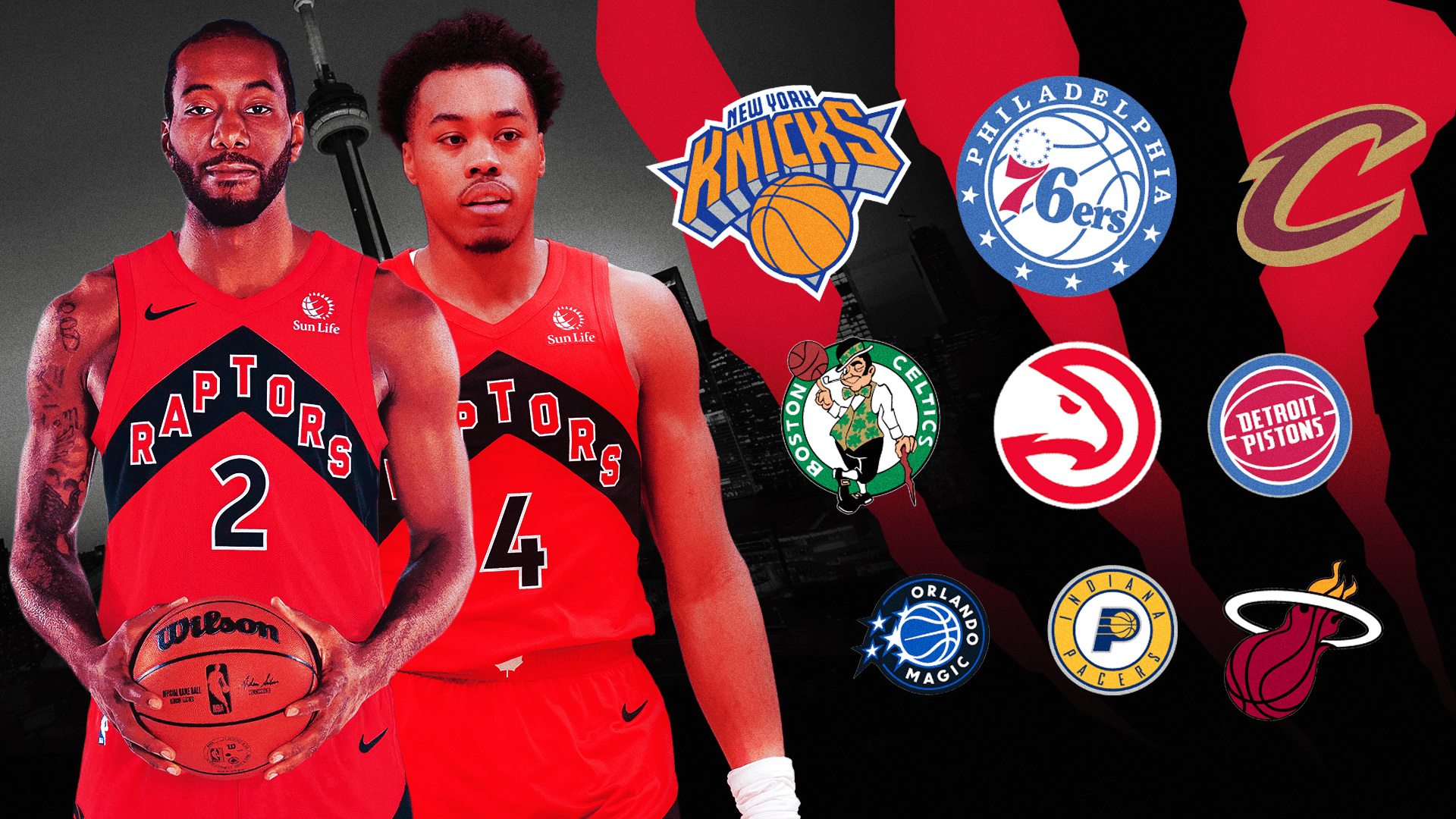
The Toronto Raptors upgraded their roster in a major way this offseason, swinging a Kawhi Leonard trade that should put them squarely in the Finals mix, reasonable health permitting. But the road to that lofty destination will be rife with obstacles, because the top of the Eastern Conference improved along with them.
The Raptors, Knicks, 76ers, Celtics, Pacers, Pistons, Cavaliers, and Heat will all enter this season feeling confident in their ability to nab one of the East’s top-six seeds and make a deep playoff run. But at least two of those teams will have to go through the play-in, and at least half of them will be eliminated before the second round. (I say “at least” because there’s always a chance that a less-heralded but still-talented squad like Orlando, Atlanta, or Charlotte crashes the party.)
With all that in mind, and with the Leonard trade finally complete, I wanted to investigate how Toronto stacks up to the competition in a conference that looks more daunting than it’s been in a generation. For the purposes of this exercise, I’m assuming Leonard has a relatively healthy season (which by his standards would mean playing something like 55-65 regular-season games) and postseason.
These teams are listed in reverse order of how much I think they should worry the Raptors. Because it’s an in-depth look, this is part two of two, and you can find the first part of the series here.
Let’s get into it.
3. Boston Celtics
Why they might be better than the Raptors
I was as mystified as anyone by the Jaylen Brown trade, but amid all the handwringing over that deal – and the Celtics’ flameouts in the last two postseasons – people have lost sight of how scary these guys can still be. They finished second in offence and fourth in defence last season (one of just two teams to finish top-five on both ends), despite Jayson Tatum playing just 16 games and shaking off rust after missing 10 months with a torn Achilles. He looked pretty close to his pre-injury All-NBA self by the time the playoffs rolled around, and that’s the guy I’d expect to see in 2026-27.
Brown took the reins and had a terrific season, but Tatum is the superior player in almost every way (particularly as a defender and playmaker), so functionally exchanging the former for the latter – plus Paul George – should be an upgrade for an already killer regular-season team. George still has plenty of utility as a 3-and-D wing, and he’ll be a hand-in-glove fit in Joe Mazzulla’s system. Mitchell Robinson will help shore up the Celtics’ shaky centre rotation and generate a ton of extra possessions for a team that scores like gangbusters off of offensive rebounds.
Derrick White should bounce back from a down offensive year that was at least partly a byproduct of Tatum’s absence (those guys make magic in the two-man game). Promising young role players like Hugo Gonzalez, Jordan Walsh, and Baylor Scheierman look ready for bigger roles, which will come in handy if Tatum needs to be load-managed or when George inevitably misses time.
As for head-to-head considerations, Boston has the defensive wing personnel (between Tatum, George, White, Walsh, and Gonzalez) to match up with Toronto’s best offensive players and switch most of the screening actions they run. Payton Pritchard is the kind of waterbug guard who always seems to give the Raptors problems. And shooting will remain a major advantage for the Celtics, who made the most pull-up threes in the league last season while the Raptors made the fewest. Kawhi Leonard alone can’t close that gap.
I’d expect Boston to finish with a better record, and won’t be surprised at all if they’re the No. 1 seed in the East.
Why the Raptors might be better than them
The postseason is where the Celtics are going to feel the loss of Brown most acutely. While they have enough guys who can step in and collectively soak up all the possessions Brown was using, they have no substitute for his ability to play through physicality and create his own shot against playoff defences. The Raptors, for example, have a handful of individual defenders and team coverages they’ll be able to throw at Tatum. Will any other Celtic be able to consistently bust a mismatch or bend the floor in the other direction?
There’s also the fact that Boston ranked dead last in rim frequency and 29th in free-throw attempt rate last season with Brown, who was easily their most potent dribble-drive threat and led the team in free throws by a mile. Tatum can account for some but not all of that loss, while George rarely gets to those spots at this stage of his career. The Raptors’ biggest defensive deficiencies are that they struggle to defend the rim and foul like crazy. Boston isn’t built to exploit either one.
The Celtics’ 3-point-heavy style isn’t quite as high-variance as it’s sometimes made out to be, because they do excel at limiting turnovers and cleaning the glass. And I don’t take their last two series losses as evidence that their approach is doomed to fail or that the rest of the league has solved them for good. But I do think I’d feel more confident in a team like the Raptors in a postseason setting; a team that can more reliably control the possession game and has many more avenues to score inside the arc.
Verdict: Raps better (as a playoff team)
2. Philadelphia 76ers
Why they might be better than the Raptors
In terms of sheer cumulative talent, the Sixers have the Raptors and every other Eastern Conference team beat. A starting lineup of Tyrese Maxey, VJ Edgecombe, Jaylen Brown, LeBron James, and Joel Embiid is terrifying. That group can mash teams in the halfcourt simply by finding and exploiting mismatches, and it also features four of the best transition players in the sport. (Embiid can probably join the fun as a trail shooter.)
Yes, LeBron will turn 42 this season, but he remains one of the game’s great problem-solvers, which will come in handy on a team that has plenty of mouths to feed and needs to build chemistry from scratch. In a role that should see him act as a fourth scoring option on a lot of nights, he can also get away with coasting for stretches. The same goes for Embiid, who’s never been afforded this level of roster protection before.
There will be a lot of “only one ball” talk given all the high-usage stars at the top of this roster, but these guys can all benefit from each other’s presence. LeBron is an enormous off-ball player who still cuts with ferocity, Edgecombe is a chaos agent with a promising jump shot, and Brown will at least threaten as a second-side creator. Then there’s Maxey, who might be the single most dangerous off-ball weapon in the league – a devastating off-the-catch attacker who’s hit 43 percent of his catch-and-shoot threes over the past five seasons.
The Sixers can mix and match their stars in myriad combinations, keeping at least two on the floor at all times. They should be able to create some killer hybrid lineups because they aren’t just stocked with top-end talent; they’ve got a pretty deep bench populated by veteran role players (Dean Wade, Kentavious Caldwell-Pope), intriguing youngsters (Dominick Barlow, Labaron Philon Jr., Justin Edwards), and one quintessential microwave scorer (Anfernee Simons).
That’s a ton of offensive firepower to deal with, even for a defence as balanced and versatile as Toronto’s figures to be. Stacking the two teams up, Philly has the advantage in the backcourt (who in that starting lineup will Quickley guard?), comparable talent on the wing, and, when Embiid’s available, a sizable edge in the frontcourt.
Why the Raptors might be better than them
While I don’t think the overlap of ball-dominant scorers is going to stop the Sixers from being a great offence, I do think there will be diminishing returns, as is often the case when teams stack stars. That’s not problematic on its own, but it might be if Philly struggles to be better than average defensively, which is my expectation.
Even setting the availability issues aside, Embiid no longer moves well enough to be a high-level anchor; LeBron’s instincts can’t make up for his aging joints; Brown has always been a below-average team defender; and though Maxey and Edgecombe are solid for their positions, they aren’t the type of guard defenders capable of masking frontcourt limitations. There isn’t a single elite defensive player on this team who can raise its overall water level.
All of which will put a ton of pressure on the Sixers’ offence to be top-five calibre, at minimum. And that’s what could amplify imperfect fit issues like Brown’s tunnel vision and static off-ball game, or LeBron’s shaky 3-point shooting, or Embiid’s ill-fitting tempo preference and being a black hole in the post. The Raptors don’t have the same level of offensive talent, but the bar for them is much lower on that end because they’re almost definitely going to have an elite defence.
This is all assuming the Sixers can even get anything resembling a healthy season out of a group that’s banking on a quadragenarian with 23 years of service time and a 7-footer who’s played an average of 32 games over the past three seasons. (How seriously can you take a team that might be asking Adem Bona and Ariel Hukporti to cover centre duties for 50 games?) The Raptors have health concerns with their own centre, but Jakob Poeltl is much less important to their success than Embiid is to Philly’s, and Toronto at least has proof of concept with a small-ball frontcourt of Barnes and Murray-Boyles that dominated in extended minutes last season.
Verdict: Tied (but Raps slightly more reliable)
1. New York Knicks
Why they might be better than the Raptors
Unlike the other teams on this list, the Knicks didn’t make any big additions this offseason, and in fact lost an important piece in Mitchell Robinson. But after one of the most dominant playoff runs of all time, an outgoing backup centre probably isn’t enough to knock them off their perch as East favourites. No one dominated Toronto more thoroughly than New York did last season (average margin of victory: 19.6 points), and while a lot’s changed for the Raptors, they have a lot of ground to make up on the team that’s beaten them 13 straight times.
First and foremost, this is still an absurdly talented offensive group, led by Jalen Brunson’s all-world halfcourt creation and shot-making, amplified by the perfect complementary skillset of Karl-Anthony Towns – one of the only true stretch-fives in the game who can also do real big-man stuff like bust mismatches in the post. That tandem is flanked by a trio of athletic wings (OG Anunoby, Mikal Bridges, Josh Hart) who insulate them on defence and bridge gaps on offence with shooting, cutting, secondary playmaking, and offensive rebounding.
While the Raptors actually have them beat in the wing department, the Knicks have the luxury of being able to comfortably play any or all of their wings next to their 7-foot centre, because of that centre’s outlier ball skills and shooting ability. The Raptors don’t even have a four who can shoot the ball like Towns, let alone a five, so finding ideal lineup alchemy will be more of a challenge for them.
The Knicks also have one of the deepest backcourts in the league, with five rotation-calibre guards on their bench (McBride, Shamet, Alvarado, Clarkson, Kolek) who give them a ton of added shooting and ball-handling juice at a time when that’s never been more important. (It’s also something the Raptors’ bench is comparatively light on.) And they’ve replaced Robinson with one of the league’s only comparable offensive rebounders in Andre Drummond, who should help maintain the possession advantage that’s been a core part of New York’s identity.
One thing that sets the Knicks apart is how seamlessly all their pieces fit together, with crystal-clear role definition and very little redundancy or overlap. There’s also the simple fact that we’ve seen this team establish a ceiling of “going 16-3 with a playoff-record plus-15.4 net rating en route to the championship.” That’ll earn you some benefit of the doubt.
Why the Raptors might be better than them
I don’t say this to dismiss what the Knicks did last spring, or downplay how dangerous they can be this spring, but I do think that run skewed the perception of how big the gap is between them and the rest of the conference.
While they deserve full credit for smoking everyone in front of them, this East will be a lot tougher, and these Raptors specifically should be significantly better than anyone the Knicks faced en route to the Finals. None of those Hawks, Sixers, or Cavs teams had nearly the level of two-way wing play or defensive versatility Toronto should bring. With the option to roll out lineups featuring Barnes, Leonard, Murray-Boyles, and Jamal Shead, the Raptors are as well-equipped as any East team to short-circuit New York’s electric offence.
The Knicks bottled pure magic for two months, and I’m not sure that’s remotely replicable. The crunch-time performances and colossal comebacks were one thing, but my main point of skepticism concerns their defence. They had the league’s best defensive rating in the postseason, and while there are obviously some very talented defenders on the team (I don’t have to tell Raptors fans how good OG is), and Towns really stepped it up on that end of the floor, I feel Toronto has more clearly defined strengths and a higher defensive ceiling overall. Especially with Robinson gone, and Drummond – a vastly inferior defender – taking his place.
It’s also just really difficult to go back-to-back nowadays. Not only have there been eight different champions in the last eight years, no team has even made a repeat Finals appearance in that time. That doesn’t prove that these Knicks can’t do it; it just illustrates how physically taxing the game is now, and how much it takes to sustain championship-level playoff performances year over year.
Verdict: Knicks better (but not by as much as some might think)