
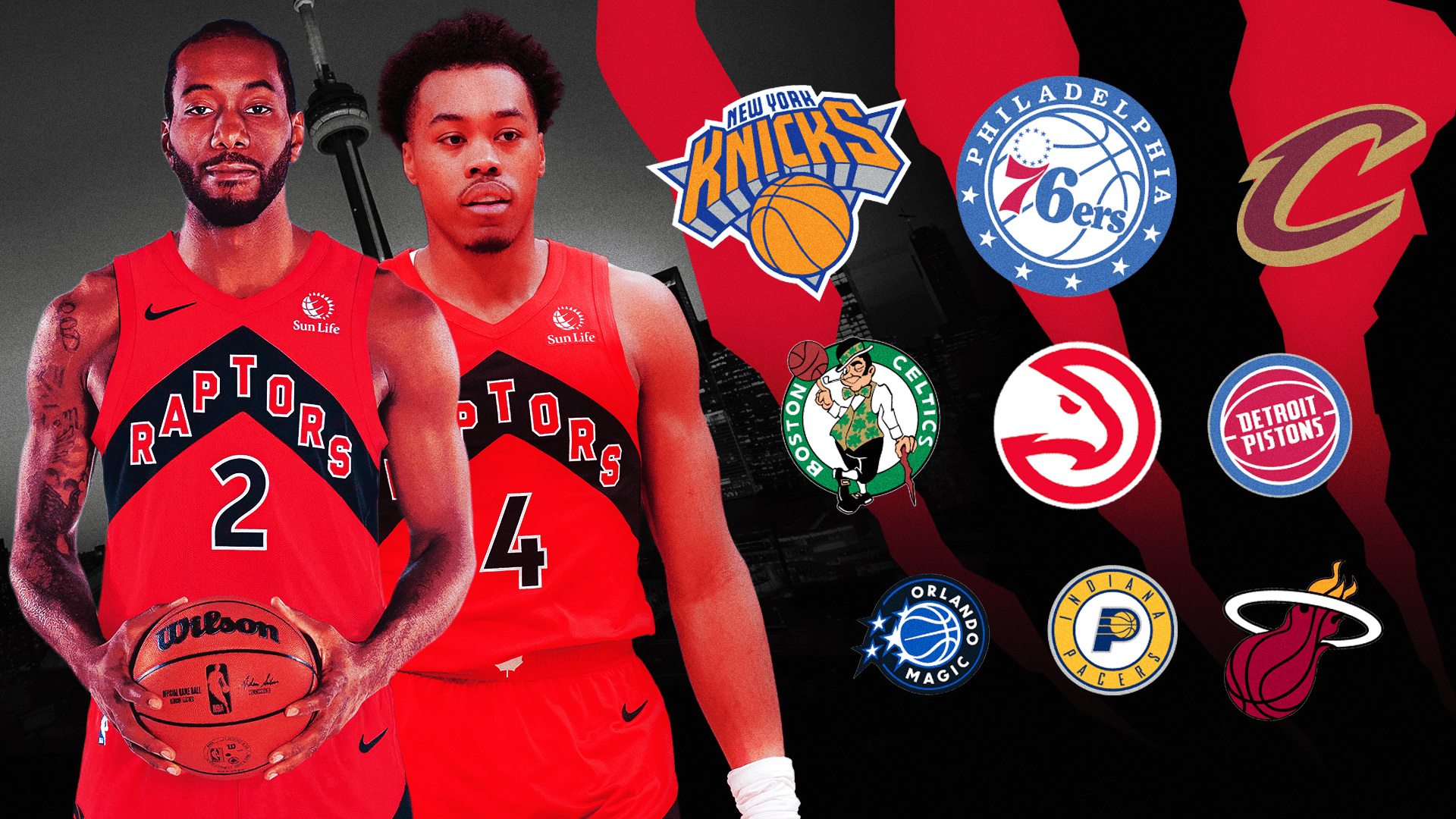
The Toronto Raptors upgraded their roster in a major way this offseason, swinging a Kawhi Leonard trade that should put them squarely in the Finals mix, reasonable health permitting. But the road to that lofty destination will be rife with obstacles, because the top of the Eastern Conference improved along with them.
The Raptors, Knicks, 76ers, Celtics, Pacers, Pistons, Cavaliers, and Heat will all enter this season feeling confident in their ability to nab one of the East’s top-six seeds and make a deep playoff run. But at least two of those teams will have to go through the play-in, and at least half of them will be eliminated before the second round. (I say “at least” because there’s always a chance that a less-heralded but still-talented squad like Orlando, Atlanta, or Charlotte crashes the party.)
With all that in mind, and with the Leonard trade finally complete, I wanted to investigate how Toronto stacks up to the competition in a conference that looks more daunting than it’s been in a generation. For the purposes of this exercise, I’m assuming Leonard has a relatively healthy season (which by his standards would mean playing something like 55-65 regular-season games) and postseason.
These teams are listed in reverse order of how much I think they should worry the Raptors. Because it’s an in-depth look, this is part one of two. Part two comes out tomorrow.
Let’s get into it.
7. Miami Heat
Why they might be better than the Raptors
Even if he’s slightly past his prime at this point, and clearly not the defender he once was, Giannis Antetokounmpo is still a force to be reckoned with. He’s still the deadliest transition weapon and most dominant interior scorer in the sport, and still almost certainly the best player in the East. His last season was curtailed by injuries and tanking incentives in Milwaukee, but his per-36-minute numbers were as eye-popping as ever: 34.4 points, 12.2 rebounds, 6.8 assists, and two stocks on 66 percent true shooting. Recall how bad the Bucks were last year, and then consider that they outscored opponents by 4.1 points per 100 possessions with Giannis on the floor. Any team he’s on deserves to be taken seriously.
The Heat are also a fascinating fit for him in a lot of ways. They play at the fastest pace in the league, and their read-based, ball-screen-averse offensive spacing concepts should provide him plenty of advantageous catches and driving lanes. Miami ranked second in drives and third in paint points last season; Giannis was the NBA’s most efficient high-volume driver, and ranked first by a mile in per-game paint scoring. In other words, he can turbocharge some of the things they already did well. And those things could pose a challenge specifically to the Raptors’ interior defence, which remains light on primary rim-protection.
Pairing Giannis with Bam Adebayo gives Miami arguably the best front line in the conference, a tandem that will be truly special defensively if Giannis can tap back into some of his DPOY-winning help-side mojo. Having him on the back line as a safety will allow Adebayo to more frequently access his most valuable defensive skill, which is switching out on the perimeter. Andrew Wiggins and Davion Mitchell can provide plenty of resistance at the point of attack and hold up on the back side of those switches, too. And between Wiggins, Klay Thompson, Tim Hardaway Jr., and Bobby Portis, the Heat have enough shooting orbiting their two frontcourt stalwarts that they shouldn’t have to rely too much on Adebayo’s nascent 3-point stroke (31.8 percent on 5.5 attempts per game last season).
Plus, you know Erik Spoelstra is going to cook up some funky schemes to get the most out of this group on both ends.
Why the Raptors might be better than them
If you thought Toronto’s backcourt situation was precarious, take a look at Miami’s. As fond as I am of Mitchell and as intrigued as I am by Pelle Larsson, this is the worst guard corps of any legitimate playoff hopeful in the East.
The Heat prioritized shooting when filling out their roster, but their guards who can shoot well don’t defend and their guards who defend don’t shoot well. Plus, to make a frontcourt with two non-spacing bigs offensively tenable, you also need off-the-dribble perimeter creation, which is in very short supply here. It’s going to fall on Giannis and Bam to do a lot of the creating for themselves and others, and while Giannis is capable of doing that to some degree, he’s at his best in a hybrid role that leans more toward finishing than initiating. That’s even more true of Bam. Despite Giannis’ presence, this team is likely going to struggle to score.
In a head-to-head matchup, the Raptors’ weakest defenders should have plenty of viable hiding places, while their best defenders – namely Scottie Barnes, Collin Murray-Boyles, and Leonard – are as well-equipped as any trio to collectively handle Antetokounmpo and Adebayo. Miami should have the edge in transition scoring, but halfcourt offence tilts heavily toward the Raptors, who have better two-way lineup balance and more ways to hurt the Heat than vice versa.
Verdict: Raps better
6. Cleveland Cavaliers
Why they might be better than the Raptors
The Cavs have a proven regular-season formula, having averaged 54 wins while finishing an average of eighth on offence and seventh on defence in the four years Donovan Mitchell, Evan Mobley, and Jarrett Allen have played together. Last season’s Darius Garland-for-James Harden swap made them a lot older, but also more reliable. Even at age 36, Harden was good for 70 games and roughly 24-5-8 per night on 61 percent true shooting.
With Mitchell and Harden, they still have a massive backcourt advantage over the Raptors, particularly in the pull-up shooting department. That was a huge reason they won the teams’ first-round series last spring, as they hit 39 off-the-bounce threes compared to Toronto’s eight.
Adding Peyton Watson also gives them the type of player previous iterations of their team have lacked: a versatile, ultra-athletic perimeter defender who, if last year’s shooting leap turns out to be real, won’t compromise their offence at all. Continued progress from Jaylon Tyson after last year’s mini-breakout would also go a long way toward shoring up that longtime weak spot. If things break right, this could be the most complete version of the Mitchell-led Cavs we’ve seen.
Why the Raptors might be better than them
Despite the consistent regular-season success, Cleveland is undone in the playoffs by the same issues every year: shaky offensive process, poor decision-making under pressure, and porous perimeter defence. Watson isn’t likely to solve those problems, especially since his arrival was offset by the departures of Max Strus (whose movement shooting and secondary playmaking were vital ingredients in the Cavs’ offence) and Dean Wade (who was easily the team’s best wing defender last postseason).
While the Cavs can theoretically draw confidence from their trip to the East finals last season – the franchise’s first such appearance without LeBron since 1992 – their run could hardly have been less convincing. They barely scraped past the Raptors in the first round despite Quickley being sidelined and a hobbled Ingram providing next to nothing. Now Toronto has swapped Ingram for Leonard, which will put Cleveland’s perimeter defence in a dramatically more compromised spot in this matchup.
Mitchell struggled badly when tasked with being a lead playmaker, especially against this frenzied and unpredictable Raptors defence, and Harden’s ability to handle the bulk of that responsibility at this stage of his career is far from certain. Can anyone else here pick up the slack? The Cavs have minimal creation on the wing, and they’ve been waiting years for an offensive leap from Mobley that hasn’t materialized. They aren’t short on talent, but the pieces don’t fit especially snugly together, and the postseason trust factor is just incredibly low.
Verdict: Raps better
5. Detroit Pistons
Why they might be better than the Raptors
The Pistons came out of nowhere to win 60 games last season, bludgeoning the Raptors in two of three matchups in the process. It’s hard to call that flukey (playoff results be damned) considering they finished with the second-ranked defence and third-best net rating in the NBA. With Cade Cunningham ascending to full-fledged superstardom, Jalen Duren making an All-NBA leap, and Ausar Thompson firmly establishing himself as one of the best and most versatile defenders in the game, they had a dynamic three-man core and a formula that involved smothering opponents at one end and letting their elite offensive engine carry them at the other. They were big, tough, physical, and altogether unpleasant to play against.
That young nucleus will remain intact (because Duren is surely going to re-sign eventually), and while the playoff letdown forced the Pistons to reconfigure the rest of the roster in a way that may sand down their sharpest edges, those changes could also make them more balanced and more dangerous. Most notably, they addressed their glaring shooting needs by adding one of the league’s better movement 3-point gunners in Isaiah Joe. Last season, Duncan Robinson was their only player who provided that skill – or any serious off-ball gravity – which is why their offence scored 10.2 fewer points per 100 possessions when he was on the bench, the sixth-biggest on/off split among all players who played at least 1,000 minutes.
In Joe they’ll get comparable offensive utility with less defensive downside. Cunningham should benefit from the improved spacing, on top of getting to use Joe as a ball-screener (or ghost screener) in inverted actions that even the league’s best defences won’t have great solutions for.
Additionally, bringing in John Collins – a hybrid big who’s much more offensively skilled than Isaiah Stewart, and a more physical presence than Tobias Harris – will make double-big lineups more viable for the Pistons. (Those lineups were narrowly outscored last season.) In a head-to-head matchup, Detroit will continue to have a massive athleticism advantage over the Raptors at centre, after a season in which both Duren and Paul Reed dominated against Toronto.
Why the Raptors might be better than them
Much as I can see the rationale behind them, the Pistons’ offseason moves in totality feel lateral at best. Improving the shooting was imperative, but they failed to address an equally (if not more) significant offensive deficiency: secondary creation. All due respect to Daniss Jenkins, but this team still doesn’t have anyone with enough on-ball juice to meaningfully draw attention away from Cunningham, or attack defenses that load up on him, or capably shepherd the offence when the ball is forced out of his hands. That roster limitation is part of the reason Cunningham averaged a borderline-disastrous 5.6 turnovers per game in the playoffs. Harris was also a stalwart role player whose ability to fill gaps and occasionally create his own shot will be missed.
Toronto, for its part, is much better equipped to defend Detroit with Leonard replacing Ingram. Not only is Leonard a dramatically better help defender who can do more to turn the Pistons’ non-shooters into liabilities, he’s also a great candidate to guard Cunningham. After a season in which the Raptors let the star guard average 31 and 9 on 69 percent true shooting against them while relying on guys like RJ Barrett and Ja’Kobe Walter (laterally slow and undersized, respectively) to handle that assignment, they can now either stick Kawhi on him or give one of Barnes or Murray-Boyles the job with a much stronger layer of protection behind them.
I also think that Stewart, despite getting played out of the rotation last playoffs, is a huge loss. Not just because of what he meant to the team’s rugged identity and general air of menace, but for practical reasons. Last year’s Pistons thrived on the strength of their defence, and their defence thrived by taking away the rim, allowing the fifth-lowest volume of shots and the second-lowest field-goal percentage inside the restricted area. Stewart has statistically been a top-three rim-protector in basketball over the last two seasons. Even with Thompson wreaking havoc as a low man and weak-side helper, the Pistons won’t be nearly as imposing at the basket without Beef Stew. That matters a lot overall, but especially in a matchup against a Raptors offence that’s going to do most of its damage on the interior.
Verdict: Raps better
4. Indiana Pacers
Why they might be better than the Raptors
The last time we saw these Pacers whole, they were going toe-to-toe with a 64-win juggernaut in the Finals, and may well have been one false step away from winning it all. A dismal gap year later, Tyrese Haliburton is rejoining a roster that looks very similar to the one that surrounded him the last time we saw him on an NBA court, when he tore his Achilles early in Game 7 of that Finals series in Oklahoma City. Eight of the top-10 minutes-getters on that team are still here, the biggest change being that Myles Turner has been swapped out for Ivica Zubac at centre – which represents a stylistic shift but a significant talent upgrade. Bennedict Mathurin has also been replaced in both role and spirit by Kelly Oubre.
Whether or not they’re able to pick up where they left off 15 months ago, we know these Pacers have a top gear that few other teams can match, and a proof of concept that the Raptors, as of now, do not. Haliburton’s unique processing and passing ability allow them to play with unrelenting speed while avoiding the kinds of mistakes that typically come as a tradeoff for being a fast-paced team. And when the game slows down, Pascal Siakam can still go get a bucket with the best of them. At the defensive end, they like to pressure and pick up full court, and while lots of other teams (including the Raptors) have jumped on that trend, few can execute it as well as the team that employs T.J. McConnell and Andrew Nembhard. Their depth also facilitates their frenetic play style, and they probably have the Raptors beat when it comes to sheer volume of viable rotation players.
While Toronto is undoubtedly stronger on the wing, Indiana has a huge advantage at guard and centre. Losing Turner’s shooting from the five-spot will force some realignment from the Pacers, but that should be offset by Zubac’s vastly superior screening and interior finishing. If you remember how lethal the Harden-Zubac pick-and-roll was in L.A., it should be easy to imagine how much Zubac and Haliburton can do for each other at the offensive end. And that’s to say nothing of the boost Zubac will give Indiana’s rim-protection and especially rebounding.
This is just a well-rounded team with a lot of its bases covered, and arguably a stronger sense of identity than any other team in the conference.
Why the Raptors might be better than them
Even if (and it’s a big if) Haliburton can get right back to the level he was playing at before the Achilles injury, there’s reason to wonder whether the Pacers can replicate the run they made in 2025, which was driven in large part by preposterous clutch-time shot-making. That was a pretty ho-hum team in the regular season, and we saw last year how bleak things can get when Haliburton misses time.
More specifically, I think Toronto is a really bad matchup for Indiana, whose biggest weakness is wing defence. I don’t think the likes of Aaron Nesmith, Jarace Walker, Oubre, and Siakam (who’s a much better help defender than on-ball defender at this stage) can handle the combined skill and physicality of Leonard, Barnes, Barrett, and Murray-Boyles. This was an issue for the Pacers even before Kawhi returned north of the border; the year they went to the Finals, they still lost the season series to a then-30-win Raptors team.
Toronto is just a bit stronger and more physical on balance, and is set up to be much better defensively. With Leonard’s arrival and Barnes’ ascension closing the offensive skill gap, that edge gives them the nod.
Verdict: Raps better (but margins are getting slimmer)
Come back tomorrow for Part Two!
