
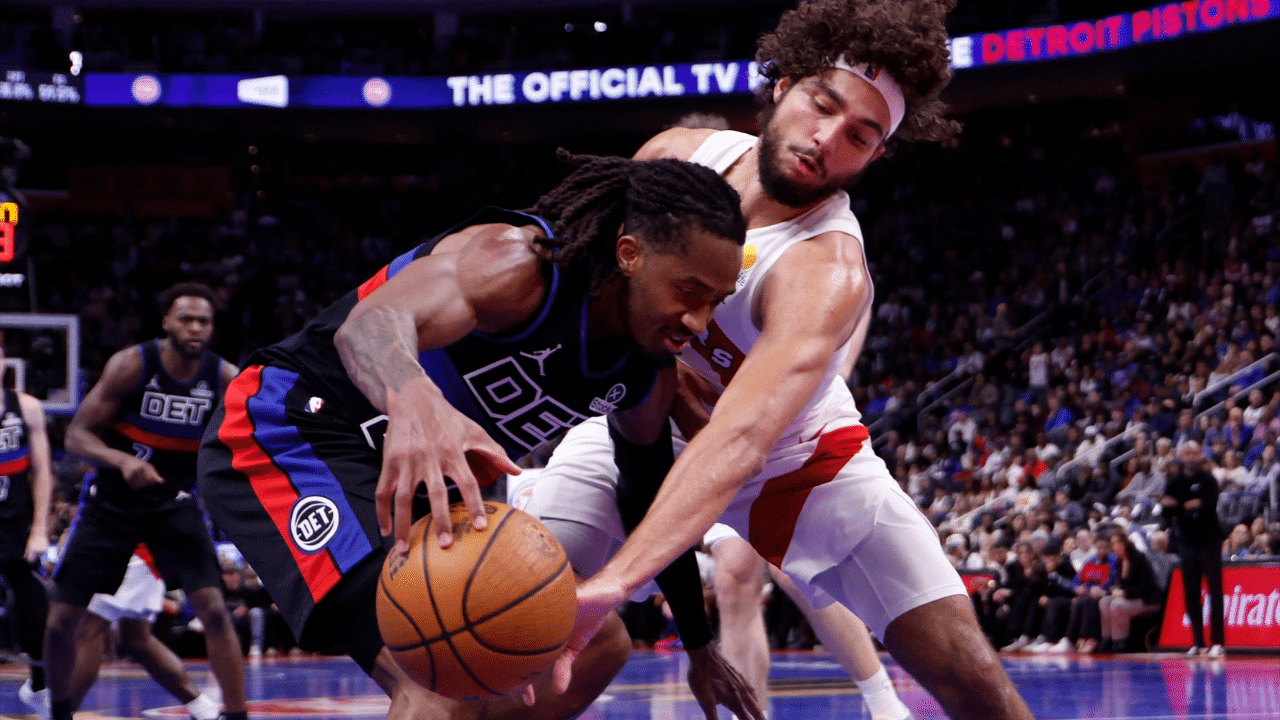
A 50-50 ball is not truly equal in the NBA. Equal chance is reserved for flipping a coin or trying to choose the right direction when putting the stretchy sheet with the tapered edges on the bed. Heads and tails. These things are equal. But the NBA is governed by predetermined biases. There is no such thing as a true 50-50 ball in NBA because the results will be predestined by the involvement of players who are taller, faster, stronger, or — in the case of the Toronto Raptors — named Allen Graves.
Graves is a rookie, and at a thin six-foot-nine, he’s somewhat undersized at power forward, let alone center. But he has a superpower. It is very small and truthfully falls under the increasingly opaque category of ‘micro skill,’ but it is a superpower nonetheless; Allen Graves has perhaps the best hand-eye coordination in the NBA.
If he were a table-tennis player, he would be a defensive juggernaut. Heck, he’s a defensive juggernaut in the NBA already, in some contexts, as a result of that superpower. But it manifests across the floor, in ways big and small. And for the Raptors, it manifested in a defining regular-season win over the Detroit Pistons that simply would not have been a win without Graves’ uniqueness.
Perhaps most obviously, Graves’ hand-eye coordination results in an insane level of disruption on the defensive end. Among all college players who’ve reached the NBA since 2008, only Matisse Thybulle, Gary Payton II, and Graves had block and steal rates at such disproportionately high levels at the same time. And that has carried into the NBA.
If you just look at the box score, Graves is only averaging 0.5 steals and 0.4 blocks per game. Not much until you realize he’s playing fewer than 15 minutes per contest. He’s had a rough whistle, so several of his handsier moments as a helper stripping shooters’ attempts before the ball leaves their hands have led to (questionable) fouls. And he’s had several deflections that haven’t resulted in turnovers generated.
But what he has put on tape has been remarkable. His ball targeting is preposterous, as his swipes and slaps generally always result in actual contact with the orange. He gets his fingers on seemingly everything, and his fingers have such kinetic force that few players can gather through Graves’ swipe and keep full possession of the ball. He pokes at dribbles, swipes at shots, and reaches into passing lanes. He saved Toronto’s bacon against the Pistons, reading Cade Cunningham’s passing lane on the final possession of the game and stepping backwards to intercept the pass and insert himself into the one-on-one duel that had been playing out between Cunningham and Scottie Barnes.
Graves isn’t a traditional rim protector, in that he’s standing upright in front of would-be dunkers and warding the ball away from the rim. But he can block shots from behind with great timing, and he is a frequent purveyor of below-the-rim contests, like former Raptors point guards Fred VanVleet and Kyle Lowry, slapping down on shot attempts before they are even hoisted at the rim. He has been a very strong tagger from the weak-side corner, tipping away lobs that went over his bigs’ hands. Take these rim protection stats with extremely large grains of sand in terms of accuracy, but nba dot com’s data has Graves as the third-best on the Raptors in terms of forcing misses within six feet, behind only centers Trayce Jackson-Davis and Jakob Poeltl.
It hasn’t just been steals and blocks. Graves leads the NBA in offensive rebounding rate among non-bigs. He crashes from the wing and tips the ball to himself. He wins the ball in crowds with length and magnetic arms and hands and fingernails. He outhustles opponents to win position, boxes out the defensive rebounders, and comes up with the ball (or draws fouls). He snatches offensive rebounds in every way imaginable.
His hands have other strengths, as well. Namely: strength. He is enormously strong, perhaps not in the core of his body (yet, given that he’s only 20 years old), but certainly in the dexterous digits of his meathook ball hunters. This helps him win rebounds when his targeting is good but another player reaches the ball at the same time. Similarly, Graves has an ever-churning motor beneath the surface, allowing him to continue crashing the glass even if a few bounces don’t go his way, or to continue slapping at the ball on the defensive end after a few fouls. He doesn’t slow down, or take breaks, or allow his opponents to do either. He crashes the glass with fervor, and then he does it again, and again, and again, until his opponents, his teammates, the viewers are all tired, but seemingly not him.
Those crashes also result in easy layups when his teammates don’t end up shooting, as a crash for an offensive rebound can double as a cut for a layup. As a result, Barnes’ assist points per 100 possessions have skyrocketed this season when playing alongside Graves, as Barnes is often that lay-down passer who finds cutters.
And Graves is shooting 74 percent at the rim, which is an excellent mark for an undersized forward with limited leaping ability. He’s not yet hitting his triples, connecting on just 28.1 percent on the season after being a completely passable standstill shooter in college. But he’s creating layups as a cutter and offensive rebounder and is adding tons of extra possessions, and he is on those merits alone a boon on the offensive end. His offensive game is missing enormous swathes of territory: shooting, dribbling, passing, much more. (He finished his college career as a very strong passer and a fairly strong shooter.) Maybe that will come, and maybe it won’t, but his presence is more than survivable offensively to this point in his career. That in itself is a win.
All told, Graves is influencing Toronto’s victory in the possession margin to a near league-leading extent. He ranks in the 99th percentile in positively changing his team’s offensive rebounding rate when he’s on the court versus off, and he’s in the 88th percentile in on-off opposing turnover rate, too. He’s in rare air alongside Jordan Goodwin, Franz Wagner, and Isaiah Jackson at motivating both of those categories to those extents. This isn’t quite rookie Dennis Rodman territory. But among history’s rookies it’s about as close as you can get as a non-big in the modern era. (Although Justin Champagnie as a rookie had the offensive rebounding down, though not the other elements.)
He joined a team that was already one of the best in the league at winning the possession battle, and he has immediately proven (at least statistically) to be the best motivator on the team at winning that element of the game. He joined a team that features Collin Murray-Boyles, Barnes, Kawhi freakin’ Leonard, Ja’Kobe Walter, and Jamal Shead, any of whom would have the best hands on many teams in the NBA. And Graves has seemingly instantly surpassed them all in that one respect.
This is nothing short of miraculous. Basically nothing else has yet migrated from college to the NBA for Graves. His jumpshot hasn’t yet arrived, not consistently. His dribbling is a wild adventure, and his passing, which was very developed in college, hasn’t yet had a chance to breathe. His closeouts have been a mess (though they’ve improved greatly in recent games), and his footwork while defending in isolation and trying to apply pressure has been sloppy. He’s been extremely positive regardless. In fact, and maybe this is burying the lede, but he leads the Raptors in on-off differential.
And there is so much of his game that should be joining him in the NBA at some point. Graves has an enormous advantage that allows him to win minutes while the rest of his games finds its way to Toronto. He has a broad palette of skills that are in development, and he has to this point more than earned the chances to develop them while on the NBA court.
Graves has already proven himself to be a miracle. We’ll find out just how much better that miracle can allow him to grow going forward.
