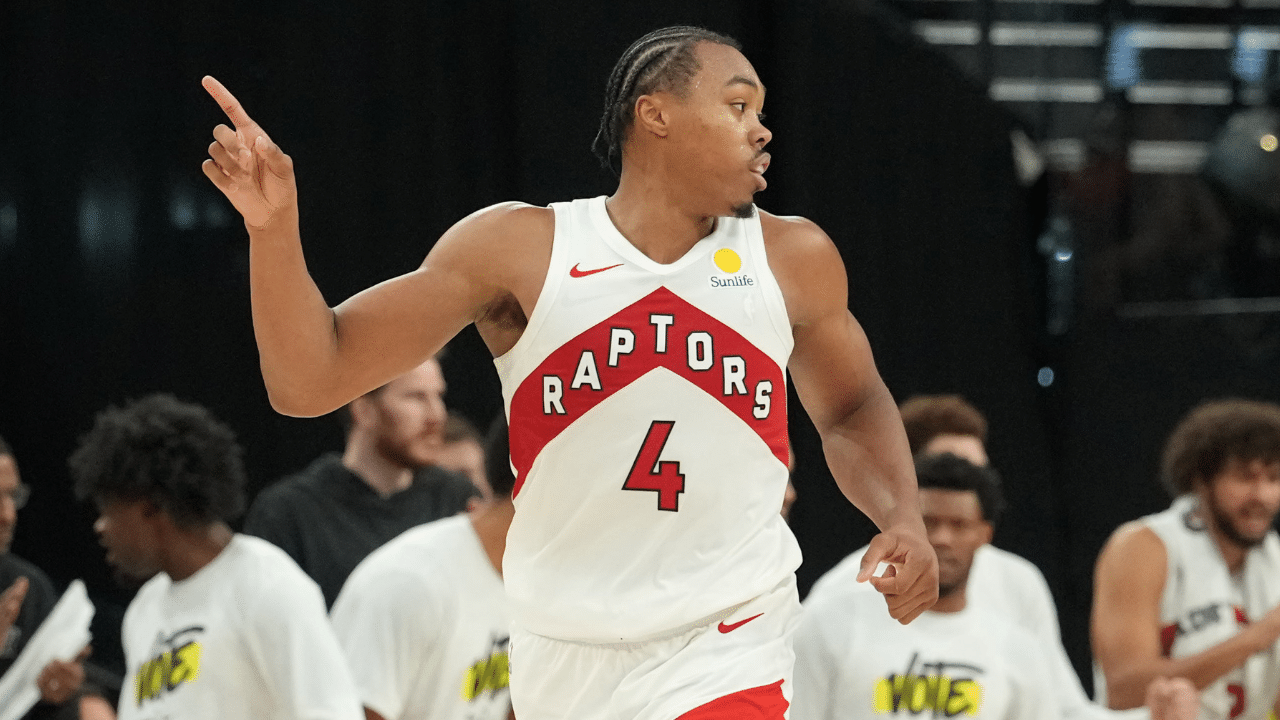

Scottie Barnes opened the Toronto Raptors’ game against the Detroit Pistons with an allegory. He drove against one of the league’s best defenders, Ausar Thompson, on the very first possession of the game. He reached the mid-range without getting past Thompson, so he picked up his dribble and stepped through. Still, he didn’t get past Thompson. He leaned to the side, practically falling, and lofted a somehow on-balance push-hook hybrid at the rim.
Ultimately, he created no separation from his defender, drew no second defender, created no advantages, and only reached the midrange. But he made the shot.
There is a tension to Barnes’ season for the Raptors at the moment. On one hand, entering the Detroit game, he was averaging, by far, a career average in points, with a leap of almost four points per game to 23.8 this season. On the other hand, he was near his career low in efficiency on those shots, with a true-shooting percentage of 52.9 percent. In fact, among the 23 players (including Barnes) averaging that many points per game or more, Barnes was tied for last with rookie Darius Acuff jr. for the lowest true-shooting percentage. No one else in the group was close to the two of them for inefficiency.
Barnes is taking more mid-range pull-up jumpers than anyone not named Shai Gilgeous-Alexander, Jalen Brunson, or Luka Doncic. He is shooting them far, far less efficiently than those other league leaders. He isn’t making his triples or his free throws, and he’s taking a career low frequency (tied) of shots at the rim.
He has proven to this point of the season to be a good scorer, but not a great one, who is extremely overtasked in Toronto’s anemic half-court offence. To that point, Barnes is in the top 10 in the league in usage rate.
It hasn’t just been scoring that has seen a change this season. Barnes is averaging a low in assists since his sophomore year despite having the ball in his hands much more than he ever has before. The theory to this point in his career has been that he needs to weaponize his scoring in order to draw more defensive attention, more double teams, which will open more passing lanes. But now that he is taking more shots than ever, he actually has fewer passes available. That has largely been because of where he’s taking his shots: the midrange, where he’s not drawing nearly enough crowds. He isn’t getting his hips past his primary defenders, so he isn’t engaging the second level of defence with enough frequency. Defences are content stunting and swiping at him, and he isn’t nearly consistent enough at bursting past those fake defenders. Thus defences are not sending multiple players, so he’s been forced to shoot rather than pass. And on those shots, he’s been good, just not good enough for the Raptors to build the boat out of them.
As a result of all this, the team’s offence has actually been worse with him on the floor versus off.
All of this is true, and it’s nuanced, and it’s contextual, but there is a broader point that is more important. Barnes is being defended by every team’s best defender, and he is leading his team in scoring. He is guarding every team’s best offensive player, and he is leading his team on the defensive end. This is more significant than true-shooting percentage.
And against the Pistons, Barnes had all of the good — leadership on both ends of the floor — with none of the bad, as he shot six-of-six from the floor in the first quarter. He controlled the floor without speeding up, hitting his mid-range jumpers, but contributing much more. At one point late in the half, he stampeded a catch above the arc, allowing him to get past his man and engaging the big defender, forcing a step up. It was an easy laydown pass to Jakob Poeltl for the layup. In the second half, he looked for shooters around his isolations, and started turning mismatches into layups. He drove more and further into the paint as the game aged, getting a Kobe Assist (missing a layup, but drawing help to open up the offensive glass) for the game-tying basket with seconds remaining, then making the same driving, left-handed layup seconds later as the game-winner. Here’s Samson on his close to the game:
Barnes took on a herculean task to finish this game. He was the sole creator the Raptors could turn to late, taking on pressure, shot making responsibilities, and tasked with guarding Cunningham on the other side. Cunningham took on the same responsibility, as he guarded Barnes.
The Raptors star wiggled for a dunk in the halfcourt, he slithered for a middy pull, and he forced up a prayer that Poeltl would tap in.
As a result, Barnes finished 14-of-21 from the field, somewhat bamboozling Detroit’s hulking defence with his versatility and size. He didn’t make a triple and made one free throw, but he still lifted his efficiency massively in the contest. And, most importantly, Toronto won. Though the Raptors only managed 105 points, the game was honey slow, and the Raptors actually scored quite efficiently in the possessions they did have. It was a signature win, and it was desperately needed.
So where does that leave Barnes and the Raptors?
Barnes has taken steps forward this season on the offensive end. They have been necessitated by circumstance rather than by Barnes’ own skill development. That circumstance, of course, has been the absence of Kawhi Leonard or Brandon Ingram or any other hierarchy setter who can eat innings in the half court. And Barnes’ steps have been admirable, though they have also been quirky and faltering and at times moving in the wrong direction. His 3-point shot has evaporated, and the context the team can provide to get Barnes the ball on the move is largely absent, too. So what has Barnes fallen back on? Mid-range pull-ups. He can access them against any defensive coverage, and he’s making them better than he ever has. It’s an answer to the questions posed by this season, though it’s not an ideal one.
Toronto’s hope has to be that Barnes’ entire game against Detroit ends up the allegory for his season, rather than the metaphorical flourish limiting itself to the first play. Barnes used his mid-range frequency to unlock other aspects of his game.
That, in combination with exceptional defence and the miraculous hands of Allen Graves, was enough for Toronto to overcome the patrician Pistons in Detroit. The Raptors weren’t just down Leonard, but also Collin Murray-Boyles and RJ Barrett. It’s clear that the Raptors have enough to hold the fort while they’re suffering from injuries. They have been competitive in game after game, even against some of the league’s best. Their failings in those contests largely came down to relying on difficult shot-making, rather than being able to create easier looks.
If that defines Toronto’s season, at least until health returns, then so be it. Barnes proved against Detroit he can manage Toronto’s structural limitations and still outduel one of the league’s best. Barnes’ 2026-27 season has been a step forward, though underwhelming at the same time. But if the Detroit game is a waypoint, then the Raptors can tread water until the cavalry returns to empower Barnes to be far more than he has been able to be to this point.
Until then, expect plenty of middies.

TABLE Fare + Social is a vibrant food hall in the heart of Toronto’s financial district, offering a unique dining and social experience just steps from transit and the arena—perfect for pregame meals before tip-off. Open weekdays from 11am to 10pm, TABLE serves up morning treats, creative eats, and lively after-work events. With a private terrace overlooking Toronto’s elevated park, guests enjoy stunning views alongside year-round programming that includes food tastings, cooking classes, live music, and pop-up events designed to spark connection and creativity.
Follow along @Tablefood hall or tablefoodhall.com