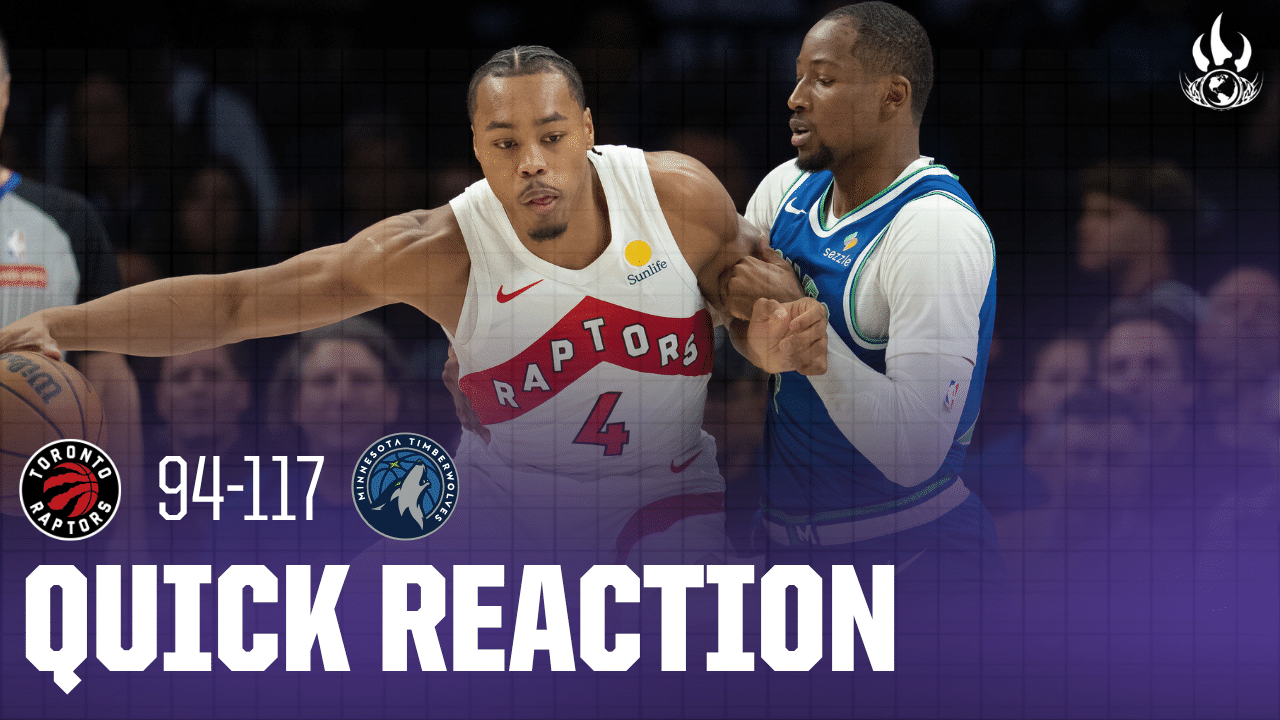

In a new NBA season, every game yields a cavalcade of lessons. For the Toronto Raptors, they learned from their drubbing received from the Minnesota Timberwolves that they have a host of issues. Resilience, ruggedness, and reliability are not among them. Perhaps that is a positive. But the negatives far outweighed what silver linings there were to be found.
For the Raptors early on, it was one battle after another. There were two main fronts in the war. On one hand, the Raptors couldn’t shoot a lick. No, it was worse than that. They couldn’t initiate offence in the least. There were misdribbles, mishaps, mistakes of all kinds. On the other front, the Timberwolves couldn’t miss their jumpers. They opened five-of-six, eight-of-12, from deep. They were piling on the triples. At one point, Ja’Kobe Walter almost stole the ball before fumbling it away, which led to the ball bobbling into the hands of Anthony Edwards. He casually hit a triple that was almost blocked.
And yet the Raptors fought back into the game. Against the Wolves’ superior talent — Kawhi Leonard was out with knee swelling, more information will be released early this upcoming week — and the Raptors’ own offensive inabilities, Toronto fought back into the game. Collin Murray-Boyles set a bone-shaking screen, caught the ball, and dunked it. RJ Barrett drove for a layup. (In general, as Toronto floundered early, Barrett’s paint touches were the only thing going for the Raptors.) Murray-Boyles chased down Jonathan Kuminga and erased his dunk from behind. Ja’kobe Walter drilled a triple, then Immanuel Quickley, and Walter again. Scottie Barnes blocked Edwards on a double team, then Quickley scampered behind the arc after setting a back screen in a Spain pick and roll and hit yet another triple.
And the Raptors trailed by only eight.
Despite Toronto connecting on its field goals at an accuracy rate almost 20 percentage points lower than Minnesota in the first half, despite Toronto attempting fewer free throws, despite Toronto committing multiple bone-headed, unforced turnovers: the Raptors remained in the game. Resilience was not a problem, at least not in the first half.
Yet that doesn’t erase the problems that the Raptors did face. Not even close.
The Raptors lack all kinds of 3-point shooting, but especially pull-up shooting. Quickley hit some triples to end the first half, but he was wayward for the vast majority of that half. And no one else was even interested in attempting such shots. There’s a common belief that a team can simply dial up the types of shots at which it is good. Oh, you can’t hit pull-up triples? Just take catch-and-shoot triples. But ability in one category catalyzes and unlocks volume in the other. With Toronto unable to threaten pull-up jumpers, no one outside of Barrett was able to drive into the paint, and no open, in-rhythm catch-and-shoot jumpers were available.
Barnes especially found himself on the outside looking in on what flow and system the Raptors were running. He has shown himself entirely disinterested in driving past stunts or digs so far this young season, and as a result he was left shooting over the top of enormous defenders. He didn’t make a field goal. He wasn’t able to initiate because his jumper wasn’t unlocking anything, and his drives weren’t reaching the paint. And his teammates’ initiation didn’t unlock anything for him either. As a result, Barnes was relegated offensively to a garbage man, occasional screener, corner spacer, and offensive-rebounding crasher. All of that coalesced into a horrid amoeba of zero points.
And those existential flaws inherent to Toronto’s roster — only exacerbated by the absence of Leonard — doomed Toronto in this contest. Sure, resilience brought the team back into the game. But those issues ensured Toronto’s head would remain at best only just below the water line. And they didn’t stay at best for very long.
Toronto started to commit awful turnovers once again, and Minnesota started to record highlight transition lob dunks. Toronto’s transition defence collapsed. What had been a lead of eight ballooned to 20 quite quickly. Murray-Boyles’ defensive terrorizing can only paper over so much.
Walter hit a side-stepping double-clutch triple. Minnesota answered with a calm, open, catch-and-shoot triple of its own fewer than 10 seconds later. At one point, Barnes drove into Minnesota’s backup center and traveled in his bizarre attempt to loft a backwards scoop shot. When Murray-Boyles’ defence started to show cracks, and the Raptors could no longer depend on transition attempts, the game was rendered moot.
The thing that matters most going forward is how Barnes fits within this team. This loss to the Timberwolves was of course a vicious cycle. At one point he smoked a transition layup to miss his 11th consecutive shot to open the game. But his current offensive approach goes beyond this one floor.
We know what Barnes looks like when he’s fitting with this roster. We saw it during the playoffs. He drove 22 times a game during the 2026 playoffs, which ranked top 10 in the league. He’s down to 6 drives a game this season.
Barnes isn’t getting the chance to dominate physically. He is floating through offensive possessions, not getting the chance to impose himself on games on that end of the floor. Some of that is on him and his decision-making with the ball in his hands, certainly. He needs to attack more and actually reach the paint. He needs to drive past digs and actually create layups for himself. His passing isn’t being unlocked, either, because he simply isn’t reaching dangerous parts of the floor in motion. As a result he is just shooting, shooting, shooting over the top of defenders. He’s a good mid-range shooter. Not good enough that this process can create good offence.
And much of the problem must rest on the shoulders of Darko Rajakovic. It is clear that the offence has been re-engineered around Leonard. Much of the structure of the offence exists to get Leonard looks in flow and in his comfort zones. The secondary creator so far this season has been Quickley. And even with Leonard sitting, it seemed as though the Raptors wanted to keep Barnes in the role for which they intend Barnes, and shift creation further onto Quickley and Barrett, rather than give more to Barnes.
None of this is going to win basketball games. Perhaps it will be best to have Barnes ready to dominate in his new role in the playoffs. But having Barnes play away from his strengths in search of future optimization will not help the Raptors reach those playoffs. And the Raptors have proof of concept. Barnes annihilated the 2026 NBA playoffs. He was one of the best five or 10 players through the first round of the playoffs. His performance there was surely some of the reason Leonard wanted to return to Toronto in the first place.
But that Barnes is not this Barnes. He has scored zero points in one previous NBA game. It came in 2023 when the Raptors still won by 20 points. This was not that. The Raptors were beaten up and down by the Timberwolves, and Barnes was nowhere to be seen.
He finished with zero points and a game-low minus-27. Yes, the Raptors lost the Timberwolves, and yes, the Raptors failed their first test of the season. But Barnes’ place within the team is a far larger question than what went wrong in this one. At least the Raptors have had that question posed to them in a staggering way.
What happens next, and how both Barnes and Rajakovic and all the other Raptors choose to answer that question, will go a long way towards defining the opening stretch to this crucial Raptors’ 2027 season.